

Pardon the length of this post, its a detailed discussion that we thought should be out there. This week, Christian was solo while Ayelet celebrated her 30th birthday with friends in LA.
Backstory
This all started around July 6th, when Bloomberg reported and Reuters confirmed that Vista was making a move on Criteo at an implied valuation “50% above” its stock price at the time. There wasn’t much detail on the offer structure, just the 50% premium headline.
Originally I speculated that Vista was leaking the story to strike up discussions or push a sale process. But I had a couple of back channels this week, and both sources suggested it might have been Criteo that leaked the story, to test the market’s reaction. That’s believable, because Criteo is something of a leak engine. Past leaks about potential acquisitions that never materialized have included Microsoft, Walmart, and a rumored Criteo acquisition of Skai a couple of years ago that never happened. Criteo appears to have a comms challenge that keeps repeating itself: rumored deals that never come to fruition. Their PR team is either not empowered to address the press, or the CEO thinks silence is golden. Either way, this is a business that, absolutely needs to be taken private.
The Headline Thesis
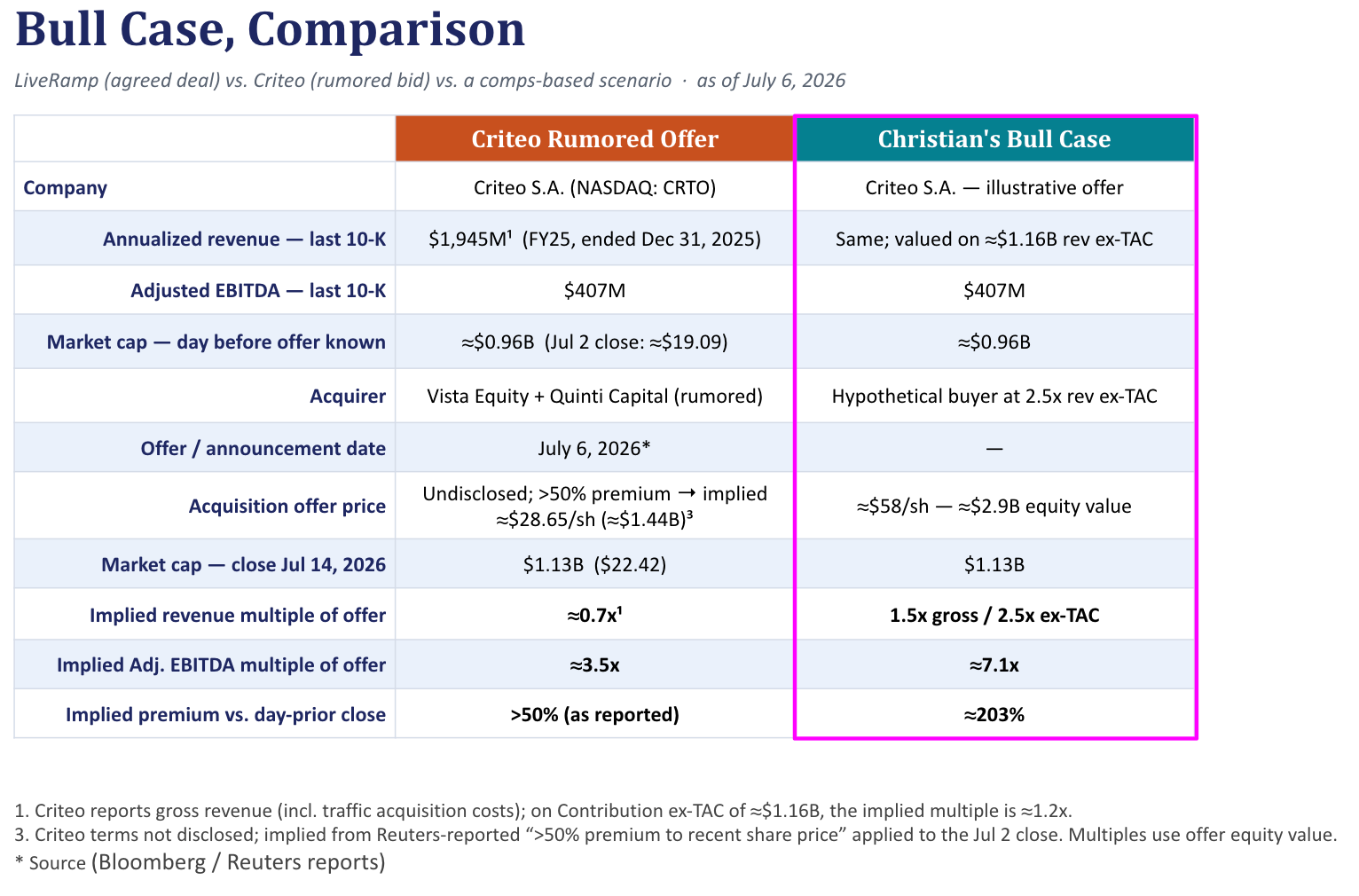
Here it is up front: pay 2.5x revenue ex-traffic acquisition (ex “TAC”) costs for Criteo, then run an M&A play to build the agentic commerce and media OS for retail and brands.
This is counter to a “buy it cheap” thesis. Instead it’s buy decisively, then spend another $1 to $2 billion at the top converting the story from “declining retargeter with a light agentic play” into a real agentic commerce media platform, doing it during a software winter when other interesting assets can be acquired at attractive prices and structures. Note I said attractive, not cheap.
And we have a useful benchmark: the Publicis proposed acquisition of LiveRamp, which is going through process right now. They’re both ad tech, not wildly different businesses, so a side-by-side is genuinely instructive.
Criteo vs. LiveRamp: The Side-by-Side
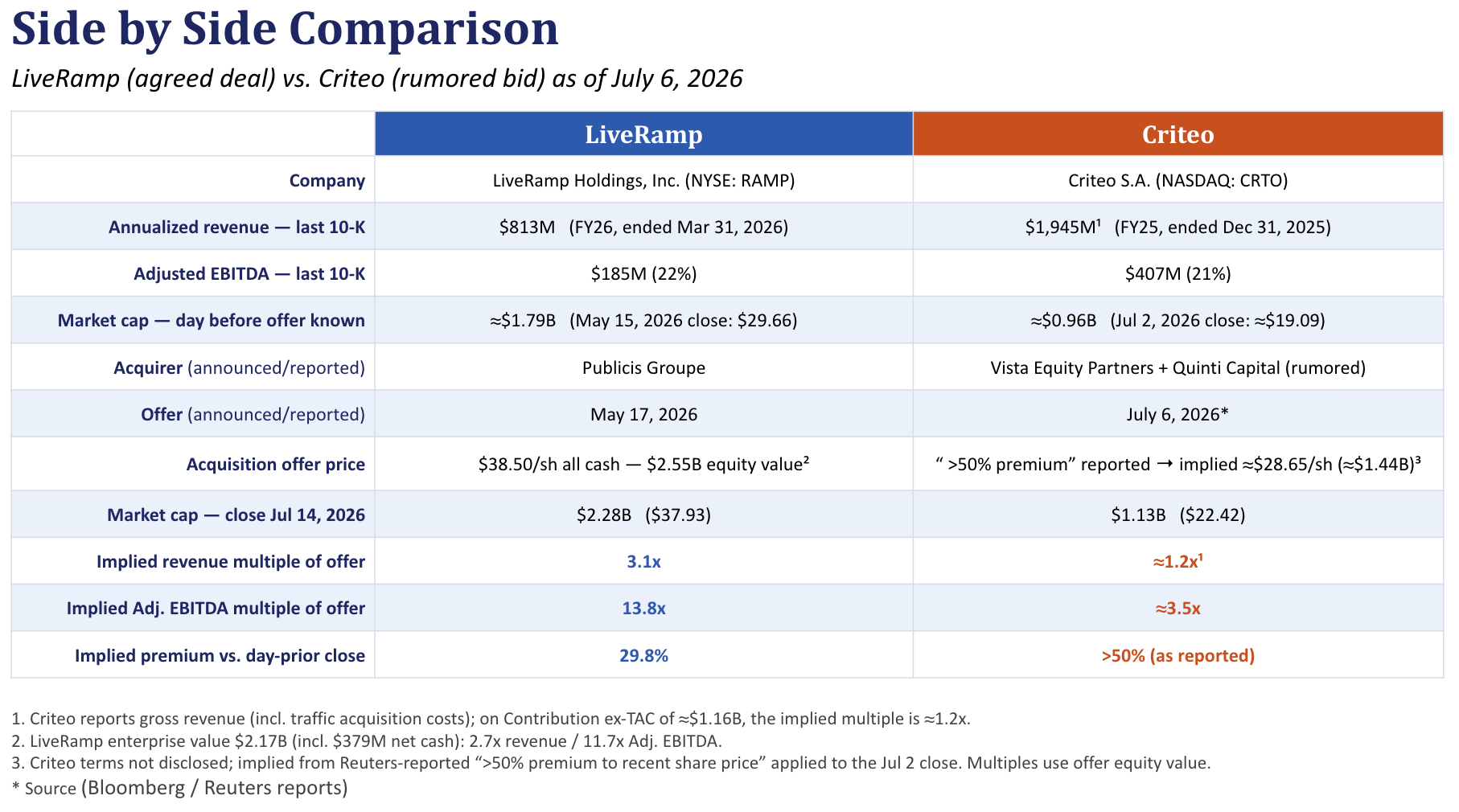
Revenue growth. LiveRamp is growing around 9%, a re-acceleration. Criteo has been growing about 1%, though ex-TAC the rate looks a bit higher, still low single digits. LiveRamp is principally a subscription business with ~107% net retention; Criteo had been deteriorating and guided to low single digits.
But growth quality is where it gets interesting. LiveRamp’s 107% retention is real today, but everyone is already talking about the churn LiveRamp will endure once Publicis owns it. Firms competitive to Publicis will likely not stay on the LiveRamp platform if it’s owned by Publicis. That 107% is very much at risk. On the Criteo side, its largest retail media client cut managed services, roughly a $25M hit in 2025 scaling toward $75M by October 2026 (Roundel and Uber Eats stepping out). But exclude that churn and the TAC, and retail media grew +16%, against a category growing 20-30%. So it’s roughly representative of the market. Churn risk needs to be priced into any PE deal here, but side by side on growth quality and retention, I think they’re closer to equal than people assume.
Revenue type. LiveRamp is true SaaS, 76% subscription, 24% marketplace and other. Criteo is largely transactional media economics, no subscription, revenue is ad spend flowing through the platform in a space where spend is growing 15%+, with Europe as long-term upside. Ex-TAC that’s about $915M. On mix, LiveRamp is unquestionably more attractive because it’s recurring. But here’s the counterpoint: a lot of subscription models are under fire in the agentic era. As a buyer, you might argue Criteo carries less risk precisely because you already know the transactional risks you’re working through, in a climate where the market is moving to tokens, transactions, and success-based pricing. The heart of the multiple gap is Publicis paying ~3.1x for recurring subscription revenue with 107% retention that I think is at risk, while Criteo is selling media outcomes priced every quarter.
EBITDA. Case in point #1; LiveRamp’s adjusted EBITDA is ~$185M. Criteo’s adjusted EBITDA is ~$407M. Criteo is the more profitable business on comparable footing, yet it commands roughly a quarter of LiveRamp’s EBITDA multiple, ~3.5x versus the ~13x proposed for LiveRamp.
Free cash flow. Case in poing #2; LiveRamp’s free cash flow is ~$166M (20% of revenue), with $379M cash on the balance sheet. Criteo has ~$211M in free cash flow (~18% of revenue ex-TAC), $371M cash, and no long-term debt. Both are cash compounders. At the rumored $1.4B equity value, a buyer gets Criteo at roughly 7x free cash flow before any leverage.
So the more you compare these two, subscription conversation aside, the more the financials look similar. They do different things in the market, but the asset quality is comparable. Which is exactly why the Vista lowball in my view is exactly that.
Caveat: we’re not comparing apples to apples in another way, Publicis is a strategic buyer, and strategics pay up. Vista is a financial buyer and more value-oriented. But Vista is typically fine paying 10x+ EBITDA for the right software business. So there’s still a gap.
The AI option value nobody’s pricing. Criteo was the first ad tech partner in OpenAI’s ChatGPT ads pilot. In May they said AI-referred conversions were 2x search in some categories, promising, if early. They also have agentic commerce recommendation services, which is a fast evolving facet of commerce. None of that appears reflected in the offer. The real asset underneath it all: 225 retailers and 4,100 brands. I look at the value as those 4,100 brand customers you could cross-sell and those 225 retailers, and what you could do with that network once it’s private and out of the spotlight.
The Bull Case, and the Christian Math
So this is a bull case: offer $58 a share, roughly $2.9 billion in equity value. That’s 2.5x revenue (not the three-to-four I threw out last week; I’m checking myself), roughly 7.1x adjusted EBITDA, and about a 200%+ premium to the undisturbed price against a ~$1.13 billion market cap business.
I know, a ~200% premium; follow me. Criteo has had trouble getting itself unstuck. This is a deliberate payup versus a rumored ~$29 bargain bid, and a price like this is one no board can responsibly ignore. They’ll be hard pressed to run a long, drawn-out formal process with this kind of offer on the table. It’s a clean mandate to transform the business. The thesis isn’t buy cheap, it’s buy decisively.
The M&A Play: Fixing Criteo’s Biggest Gap
What’s the number one gap in Criteo’s business today? No Amazon and no Walmart, the two most material retail media players. Two ways to solve it, plus one interesting play to upsell to brands and retailers.
Skai. Acquiring Skai gets you into the omnichannel media buying platform brands and agencies use, plus search, social, and some retail networks. The kicker: Criteo and Skai already know each other from prior rumored talks. This is probably the more value-oriented deal (not cheap, but value-oriented with good structure).
Pacvue. This gets you Amazon, Walmart, and Instacart muscle, a great diversification from Criteo’s current ~225 retailers. The wrinkle is that Pacvue also owns Helium 10, which doesn’t obviously fit Criteo’s post-acquisition life, but that’s solvable through a spinout.
Digital shelf analytics. For the 225-retailer base, a digital shelf analytics platform (Shalion, eStore Brands, and others) is very fitting, addressing content, pricing, availability, share of search, and increasingly media activation and closed-loop measurement. Profitero was acquired by Publicis, so this is defensive, and it adds revenue and capability that brands and retailers need.. You could also look at the Aperiam VC portfolio Kevel or ID5.
In closing, that is my bull case, love it or not; that is the play I would run if it were my decision and capital on the line.
The Week in Deals
There were seven or eight deal announcements this week; here’s the full run, which we’re increasingly moving to the Substack because there are too many to cover on air.
Agency & Media
Podean → Social Commerce Club (announced Jul 15; closed June). Rationale: bolt on TikTok Shop expertise so client wins carry across to Amazon, Walmart and owned-site sales. Price undisclosed (confirmed by SCC’s sell-side advisor, Tower Partners). Podean is the largest independent global marketplace agency (465 people, 21 countries, $600M+ media spend), backed by Mountaingate Capital. SCC is a TikTok Shop “Platinum Partner,” founded 2024, 70 specialists (HeyDude, Hanes, Playtex). This is Podean’s 6th acquisition in 9 months.
Brand Revolution → DDMC Event Design + Alice Events (announced Jul 10). Rationale: adds large-scale event and media capability across EMEA. Price undisclosed. Brand Revolution is an Austin-based global creative agency, 200+ staff (Owala, Dell, Crocs). DDMC is a Brussels event-design shop (Paris, Strasbourg, Lisbon). Note: it’s two entities, not one.
Clario Group → Ted Miller Group (announced Jul 14). Rationale: adds tech-sector storytelling and media relationships, plus a Miami foothold. Price undisclosed. Clario Group is an NY “AI-native” strategic comms firm. TMG is a Miami boutique PR shop (~7 yrs); founder Ted Miller joins as EVP, Communications.
Geben Communication → LBR/PR (announced Jul 10). Rationale: LBR brings deep media relationships and national placements; its clients gain Geben’s social, content, paid and AI-enabled research. Price undisclosed. Geben is a Columbus, OH PR firm (founded 2009, Heather Whaling). LBR/PR is an NYC shop (11 yrs, Lauren Banyar Reich).
Meet The People → The LOOMIS Agency + iluminere (announced Jul 13). Rationale: plant a flag in Dallas and round out the full-service offer for mid-sized clients. Price undisclosed. MTP is an independent holdco (founded 2021, backed by Innovatus Capital), now 12 brands, 850+ employees. LOOMIS is a Dallas challenger-brand specialist; CEO Mike Sullivan stays. Note: two brands, not one.
Brunner → AdSkate (announced ~Jul 16). Rationale: creative intelligence now matters as much as media intelligence, AdSkate shows not just what’s performing but why. Price undisclosed. Brunner is a Pittsburgh agency (founded 1989, 150+ staff; Aerie, Mitsubishi NA). AdSkate is an AI creative analytics platform (2019, Carnegie Mellon ecosystem); brand retained, CEO Akaash Ramakrishnan becomes Brunner’s senior director-AI.
Stirista → Alesco Data (announced Jul 15). Rationale: extend Stirista’s identity-driven platform with customer-data and analytics depth, the hard part is no longer collecting data but making sense of it. Price undisclosed. Stirista is a San Antonio data-driven marketing firm (proprietary audience data + ESP + DSP); CEO Ajay Gupta. Alesco is a customer-acquisition data provider; president Paul Theriot keeps leading it.
Drake Cooper → Gigasavvy (announced Jul 14). Rationale: extends Drake Cooper’s Southern California footprint and gives Gigasavvy’s people a bigger platform, they become employee-owners. Price undisclosed. Drake Cooper is a Boise, 100% employee-owned independent; CEO Mindy Stomp. Gigasavvy is Laguna Beach, founded 2008 (HI-CHEW, Toshiba, AAA); brand being retired, OC office stays. Only real number available: Gigasavvy 2025 revenue $11.1M [OCBJ, 7/14/26], that’s a size stat, not the deal price.
Commerce
Instacart → Arpalus (announced Jul 16). Rationale: get real-time computer-vision visibility into what’s actually on store shelves, since undetected out-of-stocks drive substitutions, cancellations and lost trust. Price undisclosed (no figure in the release; SEC full-text search returns zero hits). Instacart is Maplebear (Nasdaq: CART); 2,200+ retail banners, ~100k stores. Arpalus is an Israeli-founded computer-vision shelf-intelligence co. (founded 2019, CEO Ofir Zilberberg); >95% shelf-item accuracy on a phone camera. Tech extends to Caper Carts; feeds “Store View” (piloted w/ Sprouts).
Whatnot → Shaped (announced Jul 15). Rationale: push recommendations closer to real time, because live commerce is a uniquely hard ranking problem, inventory changes by the second and intent shifts mid-show. Price undisclosed (Whatnot is private; no figure anywhere). Whatnot is a livestream shopping marketplace (2019, LA; ~900 employees; >$6B goods sold in 2025; $225M Series F co-led by DST Global + CapitalG at $11.5B [Crunchbase News, 10/28/25]). Shaped is developer-first real-time recs/search infra (YC W22; ~$9.9M raised: $1.9M seed + $8M Series A led by Madrona). Founder Tullie Murrell + ~a dozen engineers join and will lead a new Applied AI Research group, a team-plus-tech deal with acqui-hire economics, but never labeled one.
Cytronic, $13.5M seed (announced Jul 15), a funding round, adapted scope. Round: $13.5M seed, led by Slow Ventures [Axios Pro, 7/15/26]. What/why: SF robot-first fulfillment operator that runs its own automated warehouses as a direct replacement for legacy 3PLs, claiming 30-60% fulfillment cost cuts for DTC brands. It takes balance-sheet and operational risk rather than selling robots, and expects a Series A by year-end. Founders: Kevin Gibbon (CEO, third-time founder; previously Shyp and Airhouse) and Scott Moen (CTO, robotics/logistics, Airhouse alum).
🔔 Subscribe for weekly M&A coverage on In/Organic
Connect with Christian and Ayelet
Ayelet’s LinkedIn: https://www.linkedin.com/in/ayelet-shipley-b16330149/
Christian’s LinkedIn: https://www.linkedin.com/in/hassold/