


Market Update: The Startups Coming for the Execution Grind
Two venture rounds crossed the line this past week, and both point at the same target: replacing manual campaign labor.
JustAI, a San Francisco-based AI-native marketing platform, raised a $17M Series A led by Base10, with Y Combinator and Peak XV also participating. The pitch: coordinated AI agents run strategy, creative, and decisioning, so one marketer gets the leverage of a whole team. CEO Neha Mittal (ex-Twitter, ex-Pinterest) claims roughly 5x ARR growth in about two years. Angels include the HubSpot CTO and people from Anthropic, Chime, and Notion.
Concord, based in New York and Paris (one of several Paris startups in the media mix right now), raised a $3M seed from a16z, Drysdale, Motier, and Better Angle. Their pitch: agents turn a brief into live campaigns and pace spend across DV360, Meta, Amazon DSP, The Trade Desk, and TikTok. It’s programmatic solve-decisioning, automating what they call the execution grind.
Here’s why Concord matters. Go inside many independent agencies and you’ll find teams trying to manage programmatic across channels, which is genuinely hard because every channel is different, the measurement is different, and the incrementality is different. Of course a startup would attack this. So a flag for independent agencies and anyone vibe-coding their own tooling with AI: not so fast. These startups are coming for it. One note worth flagging, given what’s next: Arthur Querou, CEO of Vibe.co, is an investor in Concord.
The Deal: Walmart Connect Acquires Vibe.co
On June 23rd, during Cannes Lions week, Walmart Connect (Walmart’s retail media arm) agreed to acquire Vibe.co, a self-serve connected TV and streaming ad platform. Think of it as the Google Ads of streaming. The deal is agreed but not yet closed, with a target close by the end of fiscal 2027. It’s a proposed full buyout.
For scale: Walmart is a ~$900B market cap company with over 2.1 million employees and roughly $713B in projected FY26 revenue. CEO John Furner took over in February 2026. The deal sponsor was Ryan Mayward, SVP and GM of Walmart Connect.
Vibe.co was founded in 2022, headquartered in Paris and New York, led by co-founders Arthur Querou (CEO) and Franck Tetzlaff (CTO), with about 190 employees. Roughly $100M in revenue and $78.9M in total funding since 2022 (a $6.4M seed, a $22.5M Series A, and a $50M Series B in 2025 at around a $410M valuation). The Wall Street Journal reported the deal at $1.4B, roughly $1.2B in cash plus about $180M in founder retention over four years. Against the revenue, that’s roughly 12-14x.
The Operator’s Read
This is a capability add, the missing demand activation layer of Walmart’s CTV stack that they’ve been building toward for nearly two years. Vibe.co slots in and makes TV ads easier to buy and measure.
The TAM question is worth sitting with. Global CTV is estimated around $42B, with the US market expected to reach ~$38B. Those aren’t enormous numbers. CTV is the fastest-growing major format at roughly 14-28% year-over-year depending on region, but Brian Wieser and his colleague on the Madison and Wall podcast raised a real drawback: they think performance TV is largely cannibalizing local TV budgets, with local at around $20B to be captured. The implied question is whether the growth rate eventually caps out. There’s plenty to capture now, but the ceiling may be lower than the hype suggests.
Still, at ~$1.4B for a ~$100M revenue business, if Walmart holds its retention, it’s a great deal and a clean capability add. Call it a three-to-four-year purchase. The price is a rounding error for Walmart, which has billions to spend on M&A. This is capture-the-flag for the next couple of years until the next set of problems arrives, and believe me, more problems are coming.
The real risk is integration. Vibe.co is a fast-moving startup (4.5 Glassdoor rating across 47 reviews); Walmart sits around 3.4-3.6 depending on whether you’re looking at retail or tech, which is expected at that headcount. When you fold a tech company into a large corporate, things slow down, and that can drain the fire that makes the magic. Then there’s the France factor. Acquiring roughly 60 employees in Paris is genuinely harder than it sounds; this is a statement about French labor rights being wildy in favor of the employee. For example, employees have strike rights, function much like union employees, and resist change unless deeply involved. Walmart surely knows what it’s getting into, but the equity treatment for French employees ahead of closing and the broader people dynamics really matter here. The people side is what makes or breaks this deal.
On market position, Ari Paparo said it best: the winners are the likes of MNTN, Tatari, Roku, and Pinterest. The biggest loser is The Trade Desk. Walmart used to be exclusive with them. Soon, Walmart will essentially own a bidder.
The Deal Architect’s Read
Think about what they optimized for. The flex here is the number and the outcome. They didn’t just take the top of the market, they took it from the one buyer who could hand them something no other could: Walmart shoppers and their first-party purchase data. Best outcome and biggest platform for what they built, at exactly the right moment. That’s a bragging right.
Here’s the make-or-break. That reported $180M retention over four years, the golden handcuffs, isn’t a bug deal for a company Walmart’s size, but it signals where they placed the value: Walmart sees real risk if the founders walk. The catch is that even after investors take their cut of the cash, the founders are walking away set for life. $180M doesn’t hold people who don’t need it. The real risk isn’t financial, it’s human. How do you keep two founders who just won and cashed out hungry inside a massive company? Or do they check out the day it stops being fun?
SPS Commerce Sells its 3P Business (back to its founder)
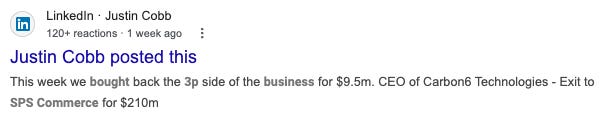
A while back, SPS Commerce acquired Carbon6 for $210M. This week they carved out the 3P recovery piece of that business, Seller Investigators, and sold it for $9.5M in cash while booking a $20M loss on the sale. They didn’t say who bought it.
Carbon6 co-founder Justin Cobb claimed in a now-deleted LinkedIn post that he bought the business back from SPS. It surfaced that the LinkedIn post had been indexed by Google but scrubbed from LinkedIn, which suggests SPS is trying to save some face on selling an asset back to a founder, we guess. The strategic logic is clear, though: SPS is exiting 3P to double down on 1P, their core (they spent $206M on SupplyPike a couple of years ago, largely a 1P play). No surprise on the direction. The only real curiosity is the confidentiality around a founder buyback that everyone will eventually figure out anyway.
Quick Hits: The Summer of Add-ons
There’s been so much activity this past month that keeping quick hits to three or four feels unfair to the deals. So, a fuller run:
Revmatics acquires DataFeedWatch from Cart.com — building a product feed engine onto Revmatics’ agentic AI. Price undisclosed; likely some cash and stock, with Cart.com taking equity in Revmatics.
Moburst acquires Hyperzon — adding dedicated Amazon marketplace muscle to a full-funnel offering. Price undisclosed.
The Independents takes a majority of Phantasm Group — a Paris production collective across film, commercials, and photography, to push luxury clients into entertainment and long-form storytelling.
Samba TV acquires Bestever (AI) — pairing autonomous ad creative with Samba’s first-party data for an agentic advertising engine.
Yes& acquires Modo Modo — an Atlanta-based B2B agency; deep in B2B branding and sales enablement, and Yes&’s third B2B buy in 18 months. B2B remains a hot category.
Arketi Group acquires Sperling — a Boston-area digital shop, adding AI and marketing depth plus paid social and UX to an Eastern Seaboard footprint (via MediaPost).
Martis Capital takes a majority stake in Deerfield Group — a healthcare and life sciences marketing agency, from Edgewater. Growth capital to expand capabilities for pharma tech clients. Price undisclosed, but per Axios Pro, roughly a $280M investment at ~12-14x EBITDA.
That Deerfield number points to something important for our PE and banker friends: there’s a very consistent marker for agencies, regardless of category, in the 12-14x EBITDA range. If you can break past 14x into 16-19x, you’re turning yourself into something strategic. It’ll be interesting to watch for evidence of strategic buyers paying outsized valuations for agencies with something genuinely strategic to offer. But 14x is the consistent gravity line right now. (MNTN’s numbers land similarly.)
Final Thought
Every summer gets a name. This one is add-on summer. Maybe it gets to 500 deals before Labor Day.


